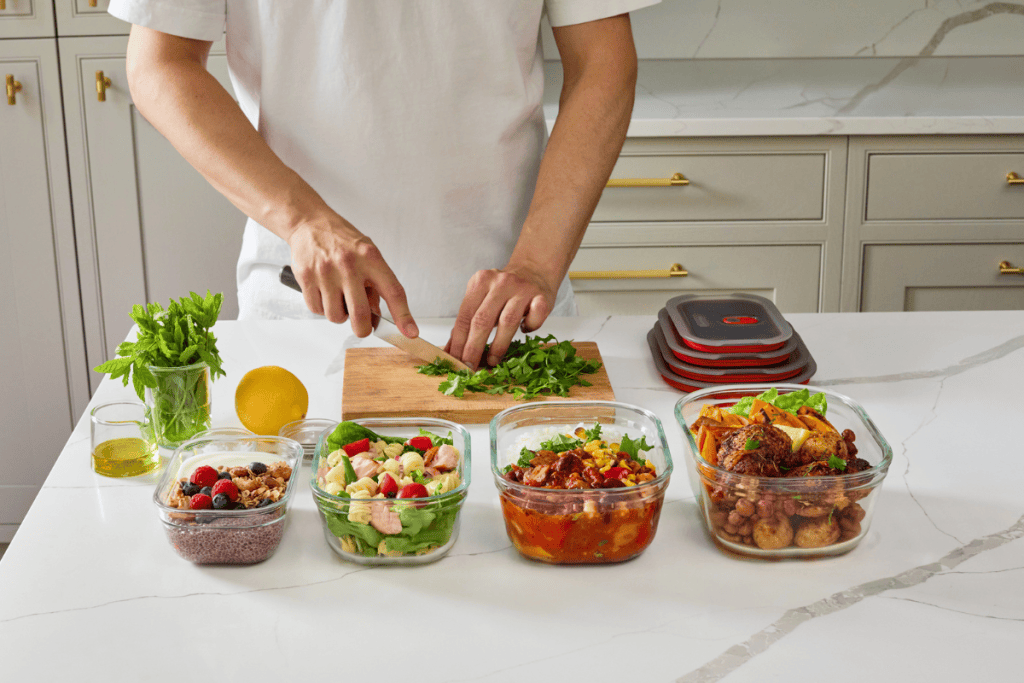
There are hundreds of meal prep containers available, and at first glance many of them look remarkably similar.
But a good meal prep container is something you may use hundreds — potentially thousands — of times. The best ones get a few important things right: the right size and shape, a genuinely leakproof seal, durable materials, easy cleaning and efficient storage.
Before choosing a set, it is worth thinking about how you will actually use it.
1. Choose the right size
For most everyday adult lunches, around 900–950ml / 30–32 fl oz is a useful starting point.
Smaller containers are ideal for breakfasts, snacks, sides and lighter meals, while larger 1L+ containers work well for pasta, curries, salads and more substantial portions.
As a rough guide:
- 380–650ml / 13–22 fl oz: breakfasts, snacks, sides and smaller meals
- 900–950ml / 30–32 fl oz: most everyday lunches and complete meals
- 1.1–1.2L / 37–40 fl oz: larger lunches, curries, pasta and generous portions
- 1.4L / 47 fl oz: large salads and bigger meals
Don’t automatically assume bigger is better. A container that closely matches your portion will take up less room in your fridge, cupboard and bag.
2. Think about shape as well as volume
Two containers with almost identical capacities can feel completely different to use.
A bowl can be ideal for overnight oats, noodles, rice dishes and meals that need mixing. A rectangular box is extremely versatile for everyday lunches and leftovers, while a wider square container can be much better for salads and meals where you don’t want everything piled on top of itself.
A good meal prep container shouldn’t just hold your food. It should be comfortable to eat from as well.
This is one of the important differences between a basic food-storage box and something that has genuinely been designed around meal prep.
3. Look for a genuinely leakproof lid

If you’re putting a container into a work bag, school bag or backpack, this is probably one of the most important considerations.
A lid that feels secure isn’t necessarily leakproof.
Look at how the seal actually works. A continuous silicone seal that makes good, even contact around the container will generally give you much more confidence than a simple friction-fit lid.
On Black+Blum’s Meal Prep and Stack + Nest ranges, we use a locking vacuum seal designed to create an airtight, leakproof closure.
The silicone seal itself has also been carefully designed with two sealing fins, giving two points of contact against the container rather than relying on a single sealing surface.
It’s the sort of detail you probably wouldn’t notice in a shop, but it matters enormously when the container is lying sideways in your bag with a curry inside it.
4. Check what you can actually use it for
“Food safe” doesn’t automatically mean “microwave safe”, and “microwave safe” certainly doesn’t mean “oven safe”.
Before buying a container, check whether the base and lid separately are suitable for the:
- microwave
- freezer
- dishwasher
- oven
- air fryer
This is particularly important with lids, as they may have different temperature limitations from the container itself.
A genuinely multifunctional container makes meal prep much easier. If you can prepare, store, freeze, reheat and eat from the same container, there is less transferring of food and less washing up.
5. Choose the right material
There is no single material that is perfect for everyone.
Glass
Glass is excellent for reheating, cooking and storing food. You can see what is inside, it resists staining and food odours, and good-quality borosilicate glass can be extremely versatile.
It is particularly useful at home, but it is heavier than metal and can break if dropped.
Stainless steel
Stainless steel is durable, lightweight and won’t shatter if you drop it. It also resists staining and doesn’t readily retain food smells or flavours.
This makes it particularly useful if you regularly carry lunch to work, school, the gym or on days out.
Black+Blum’s stainless steel Meal Prep Boxes have also been specifically designed for microwave use when used according to our instructions — although this should never be assumed with an ordinary metal food container.
Plastic
Plastic has some obvious advantages: it is lightweight, inexpensive and difficult to break.
But over repeated use, some plastic containers can stain, scratch or retain food smells. For something you intend to use for many years, we personally prefer glass and high-quality stainless steel as the main food-contact materials.
6. Think about storage when the containers are empty
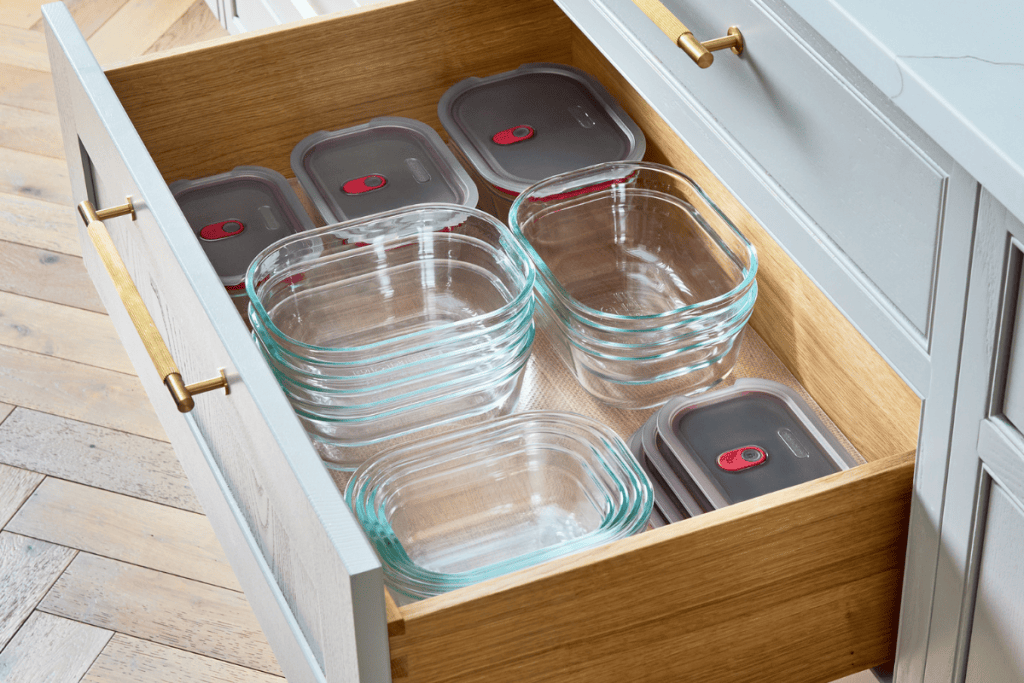
This is something that’s surprisingly easy to overlook.
Five containers might fit perfectly in your fridge, but what happens when they’re empty?
Most of us know the cupboard or drawer filled with assorted food-storage boxes. Different shapes, different brands, lids everywhere and nothing fitting together properly.
It wastes a remarkable amount of space.
This is why we think stacking and nesting should be part of the design from the beginning, rather than an afterthought.
Our rectangular containers are designed so identical sizes stack neatly, while different sizes nest inside one another. This dramatically reduces the amount of cupboard space they take up when they aren’t being used.
7. Look for a system rather than individual containers
This is an area we have thought about a lot.
Our glass and stainless steel containers aren’t intended to be completely separate ranges. They are designed as part of a connected food-storage and meal-prep system.
Selected glass and steel containers use interchangeable lids and are designed to stack or nest efficiently together.
For someone who meal preps regularly, this means you don’t have to decide between owning only glass or only stainless steel.
You can mix and match.
You might choose glass for a meal you’re reheating at home, stainless steel for something you’re carrying to work, a larger container for a salad and a smaller one for breakfast.
It also means that as your collection grows, everything continues to work together rather than gradually becoming a cupboard full of unrelated boxes and mismatched lids.
We think that makes a big difference.
8. Make sure it can be properly cleaned
Food containers need to be easy to clean thoroughly.
Pay particular attention to the lid and seal, as this is where food and moisture can eventually collect.
If the silicone seal can be removed, you can clean both the seal itself and the channel beneath it rather than leaving an inaccessible area that becomes harder to keep hygienic over time.
Our seals are designed to be removable for exactly this reason.
And because these are products we hope you’ll own for many years, we also carry replacement parts wherever possible. Losing or damaging a seal or lid shouldn’t automatically mean throwing away an otherwise perfectly good container.

A Word From The Designer
To someone who isn’t a designer or engineer, I completely understand why most meal prep boxes probably look much the same.
It’s easy to think, “It’s just a food container. They’re probably all doing roughly the same job, so I’ll buy the cheapest.”
But this is one of those products where small details make a surprisingly big difference once you start living with it every day.
Most of us have had that cupboard or drawer full of food containers accumulated over the years. Different brands and different shapes that don’t stack together. Lids that don’t fit anything — or containers whose lids disappeared years ago. They can take up an enormous amount of space.
Some plastic containers become permanently stained by tomato sauces or curries. Others get scratched, warped or pitted over time, particularly if they have been overheated or used outside their recommended temperature range.
There is also increasing research into the release of micro- and nanoplastics from some plastics, particularly during heating. The health implications are still being researched, so I don’t think it’s right to make exaggerated claims about this, but personally it reinforces why I like using durable glass or stainless steel for something that is going to be in repeated contact with my food.
The details you don’t necessarily notice
At Black+Blum, we spend a disproportionate amount of time thinking about details that most people will probably never consciously notice.
We design all our products in-house from the ground up. We carefully choose the materials, prototype extensively and test thoroughly before we put anything into production.
With our stainless steel boxes, for example, there is a subtle rib or step formed into the wall of the container.
It might look like a styling detail, but its real purpose is structural. It stiffens the thin stainless steel wall so we can keep the container lightweight while making it feel much stronger and more robust.
Look closely at our silicone seal and you’ll find two sealing fins rather than one. Again, it’s a tiny detail, but it creates two contact points with the container and helps us achieve a more reliable airtight and leakproof seal.
Then there are all the other things we’ve considered: making different sizes nest together, making lids stack neatly, designing glass and stainless steel containers to share compatible lids and making seals removable so they can be properly cleaned.
None of these things individually is revolutionary.
It’s the combination of hundreds of small decisions that makes a well-designed product noticeably better to live with.
Designed for the long term
We also think about what happens after you’ve bought one of our products.
We use the best-quality materials we can, test products extensively before launch and carry replacement parts wherever possible.
If a seal or lid eventually gets lost or damaged, we don’t want you to have to throw away a perfectly good container and start again.
For me, that’s an important part of sustainable design.
I’ve been designing products for Black+Blum for nearly 30 years and I genuinely care about every product we put our name on. We don’t always take the easiest or cheapest route, because our aim isn’t to make something that simply looks good when you first take it out of the box.
We want to make products that still work beautifully years later.
So when you’re comparing two meal prep containers that appear quite similar, I’d encourage you to look beyond the obvious things like size, colour and price.
Think about the materials. Look at the seal. Can replacement parts be bought? Will the boxes stack? Will different sizes nest? Can every part be properly cleaned? Has the product been designed as a system, or will it become another odd container in that cupboard in a few years’ time?
Those are the questions we ask ourselves when we’re designing.
And when you buy a Black+Blum product, I want you to feel confident that someone has genuinely thought about all of those details for you.
— Dan Black, Co-Founder & Lead Designer, Black+Blum
So what are the best meal prep containers?
There isn’t one universal winner.
Best everyday all-rounder: around 900–950ml / 30–32 fl oz
Best for carrying: lightweight stainless steel
Best for reheating and cooking: borosilicate glass
Best for large salads: a wide 1.1–1.4L / 37–47 fl oz container
Best for limited cupboard space: containers designed to stack and nest
Best for soups, curries and sauces: a genuinely airtight and leakproof seal
Best long-term solution: a system of compatible sizes, materials, lids and replacement parts
Ultimately, the best meal prep container shouldn’t simply store your food.
It should work through the whole process — preparing, storing, carrying, reheating, eating, cleaning and storing away again — while continuing to do that job well for years.
That’s what we think good design should achieve.