
Glass and stainless steel are both excellent materials for meal prep containers, and for long-term reusable food storage they offer several advantages over plastic. They are durable, don’t readily absorb food odours or flavours, resist staining and can keep looking good after years of use.
But is glass or stainless steel better?
The answer really depends on the food you’re storing and where you’re going to use it. In fact, for regular meal prepping, we think the most useful solution is often to have both.
Why choose glass meal prep containers?
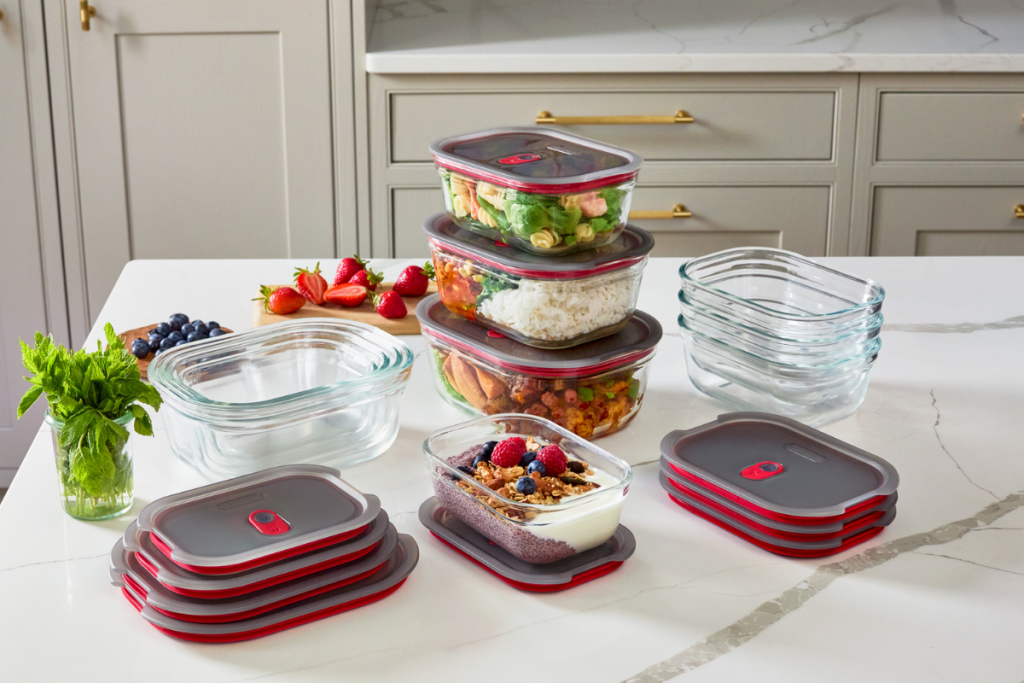
Glass is one of the most versatile materials for food storage. You can see exactly what is inside, it doesn’t readily absorb food smells or stains, and good-quality glass can often be used for storing, reheating and cooking food.
We use high-quality borosilicate glass for our Stack + Nest range. The bases are designed for use in the fridge, freezer, microwave, oven and air fryer, when used according to the care instructions.
Glass is particularly good if you:
- Regularly reheat meals.
- Want to see what is inside your containers.
- Want to cook or bake in the same container.
- Store strongly coloured or flavoured foods.
- Want something equally suited to preparation, storage and serving.
Its main disadvantage is weight. Glass is heavier than stainless steel and, like all glass, can break if it is dropped or badly knocked.
Why choose stainless steel meal prep containers?

Stainless steel offers many of the same long-term benefits as glass but is considerably lighter and extremely durable.
We use high-quality 18/8 stainless steel, which is lightweight, food safe and resistant to staining and odours. It also won’t shatter if dropped, making it particularly useful for taking food to work, school, the gym or on a day out.
Our stainless steel Meal Prep Boxes have also been specifically designed to be microwave-safe when used according to our instructions. This isn’t something that should be assumed with any metal container; the grade of steel, form of the container and way it is used are important.
Stainless steel is particularly good if you:
- Carry your meals with you.
- Want something lighter than glass.
- Need something that can withstand knocks and drops.
- Want a material that won’t easily stain or retain food smells.
- Want a container designed for years of repeated use.
The obvious disadvantage compared with glass is that you can’t see the food through the base.
Why choose glass or stainless steel instead of plastic?
Plastic food containers certainly have advantages. They are lightweight, inexpensive and difficult to break.
But if you are buying a reusable product that you hope to use hundreds or even thousands of times, we think glass and stainless steel make a lot of sense.
They resist staining and smells
Tomato sauces, curries and other strongly coloured or flavoured foods can gradually stain or leave odours in some plastics.
Glass and stainless steel are much more resistant to this, which helps them stay looking and feeling clean over repeated use.
They age well
A food container gets a surprisingly hard life: heating, freezing, dishwashing, being carried around in bags and used with cutlery day after day.
Well-made glass and stainless steel can cope extremely well with that repeated use and can continue to look good for a long time.
They encourage long-term reuse
For us, this is probably the most important point.
There isn’t much value in making something reusable if it needs replacing regularly. We would rather design a product well, use good materials and make something that people enjoy using for years.
Not just containers – a complete food storage system
When we developed our latest glass range, we didn’t want to create another standalone collection of boxes.
Our glass and stainless steel containers are designed as one system.
The rectangular containers are designed to stack when they are the same size and nest when they are different sizes, so they take up far less space when stored. Their lids have also been designed with tidy stacking in mind.
More importantly, selected glass and stainless steel containers use the same interchangeable lids.
It sounds like a simple detail, but if you meal prep regularly it makes a big difference. You can build up a collection rather than buying separate, unrelated sets, and then mix and match depending on the meal.
You might choose:
- glass at home when you want to cook, reheat or see the food inside
- stainless steel for work when you want something lighter in your bag
- glass for leftovers that might go into the microwave, oven or air fryer
- stainless steel for a picnic or day out where low weight and durability matter more
- a mixture of both when preparing several different meals for the week
Rather than deciding whether to own glass or stainless steel, you can own both and simply choose the one that works best each time.These are the all-rounders—the most popular Black+Blum option and a great starting point for anyone looking to streamline their weekly meals. Their sleek rectangular shape makes them easy to stack in the fridge or lunch bag, and their three size options let you mix and match depending on your meal portions.
The small design details matter
At Black+Blum, all our products are designed in-house.
We don’t start with an existing container and add our logo to it. We start with the problem and spend a lot of time thinking about how a product will actually be used, not just on its first day, but after hundreds of uses.
Some of the details on these containers are almost invisible until you understand why they are there.
For example, the wall of our stainless steel Meal Prep Boxes has a subtle rib or step formed into it. It adds rigidity and strength to a very thin sheet of stainless steel, allowing the container to remain surprisingly lightweight while still feeling robust. The current range is intentionally designed this way to combine low weight with strength.
The silicone seal is another example. Rather than relying on a simple single contact point, we designed two sealing fins into it. This gives us a more effective seal against the container, helping the lid remain both leakproof and airtight.
We also chose a vacuum-sealed lid lock rather than adding large clips around the edge. Pressing the button releases the vacuum, making a very secure seal simple to open. The same valve can remain open when microwaving to allow steam to escape and help prevent splattering.
The seals are fully removable too. That’s a less glamorous piece of product design, but an important one: if you’re going to own a food container for years, you need to be able to properly clean the areas where food can eventually collect.
These are all small decisions individually. Together they are what make a product work well.
Designed to be used for years
We genuinely care about every product we put into production.
Our products go through extensive development and testing before we launch them. We choose materials carefully, test how products perform in real use and continue refining details until we’re happy with them.
Our stainless steel Meal Prep Boxes, for example, have been independently tested and approved by the Good Housekeeping Institute as well as undergoing our own testing.
We also carry replacement parts wherever possible. A lost seal, damaged lid or small component shouldn’t necessarily mean throwing away an otherwise perfectly good product. Supporting products after they’ve been sold is part of designing for long-term reuse.
A word from the designer
I’ve been designing food and drink products at Black+Blum for many years, and one thing I’ve learnt is that the simplest-looking products are often the hardest to get right.
A food container doesn’t need lots of features. It needs the right features. It needs to seal every time, be easy to clean, feel good to eat from, fit efficiently in a cupboard or fridge and withstand being used over and over again.
That’s why we obsess over things that most people will probably never notice — the profile of a silicone seal, the radius of a corner, a small strengthening rib in the steel, how one box sits inside another or whether the lid from your glass box will also fit your steel one.
None of those details sounds particularly revolutionary on its own. But put them together and they make the product noticeably better to live with.
For me, good sustainable design isn’t simply about choosing a particular material. It’s about making something work so well that you want to keep using it.
So, is glass or stainless steel better?
There isn’t one winner.
Choose glass when visibility, cooking and reheating are your priorities.
Choose stainless steel when light weight, durability and portability matter more.
Or choose both.
That is really why we designed the Black+Blum range as a system. Your needs change from meal to meal and from day to day, so your food containers should be able to change with them.
Whether you’re batch cooking for the week, storing yesterday’s dinner, taking lunch to work or packing food for a picnic, you simply pick the material and size that makes the most sense.
Buy once, buy well — and use it again and again.